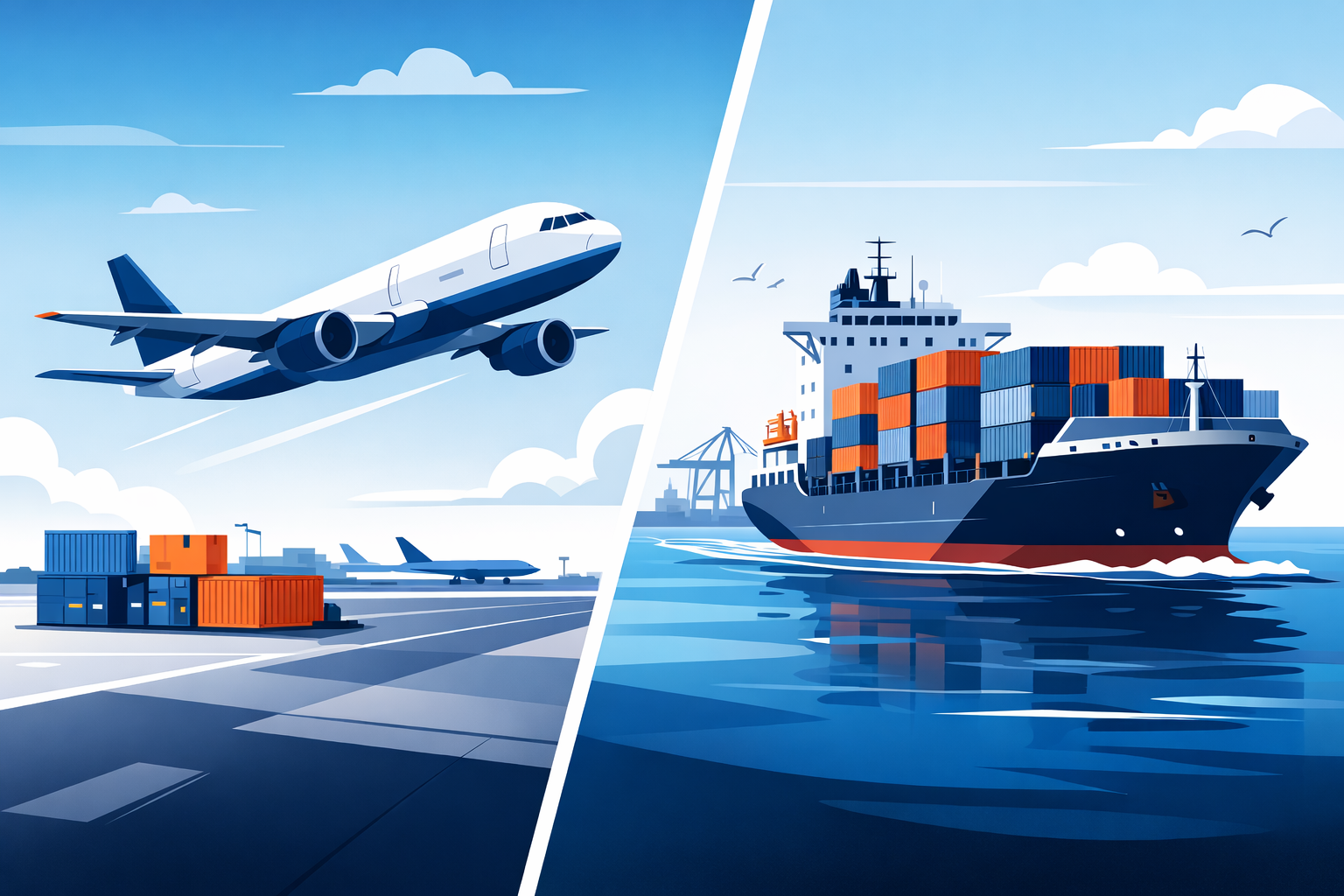
Air Freight vs Sea Freight: Which Should You Choose?
The air freight vs sea freight decision shapes your costs, your timelines, and your cash flow more than almost any other shipping choice. Neither option is universally better. The right answer depends on what you are shipping, where it is going, and what happens to your business if it arrives late.

The Cost Difference
Air freight typically costs four to five times more per kilogram than sea freight on major trade lanes. Furthermore, air cargo charges are based on whichever is greater: actual weight or volumetric weight. So a light but bulky shipment — foam packaging, for instance — pays a premium that the rate card did not make obvious. In contrast, sea freight rates are based on container volume (TEU), which tends to favor bulky but lightweight goods.
As a general rule: if your goods are worth more than USD 4–5 per kilogram, air freight is probably cost-effective. Below that, sea freight economics make more sense. Moreover, this threshold shifts significantly when demand spikes drive up ocean freight rates, as they did dramatically during 2020–2022.
The Speed Difference
On a Shanghai–Los Angeles lane, air freight takes roughly 3–5 days. Sea freight on the same lane takes 14–18 days, plus port processing time. Consequently, a business that restocks monthly can usually absorb a sea freight timeline. However, a business that responds to real-time demand — seasonal goods, trend-driven products, just-in-time inventory — often cannot.
Therefore, many businesses use both: sea freight for predictable base inventory and air freight vs sea freight analysis to decide when a fast restocking is worth the cost premium.
Reliability and Risk
Air freight schedules are generally more predictable than ocean freight. Vessels get delayed by weather, port congestion, and equipment issues in ways that aircraft rarely do. On the other hand, air cargo space is limited, and during peak periods your booking can be bumped. In addition, some goods cannot legally travel by air — lithium batteries in certain configurations, for instance — which removes the option entirely.
For fragile goods, air freight also tends to involve fewer handling touchpoints. Fewer touchpoints means fewer opportunities for damage.
When Sea Freight Is the Right Answer
Choose sea freight when your goods are heavy or bulky, your buyer’s deadline is flexible, and you are shipping full or near-full container loads. Furthermore, sea freight is almost always the only viable option for very large industrial goods. Read more about managing this process in our complete international shipping guide. For help deciding on a specific route, contact our team with the details.
Leave a Reply